PE Pipe Meaning and Key Poly Pipe Terms Including PN16, PE100 and SDR
Understanding the PE pipe meaning, along with ratings such as PN16, PE100 and SDR11, is essential when specifying poly pipe for any project. These markings determine the pipe's material grade, pressure capacity and wall thickness, and selecting the wrong combination can lead to costly replacements or system failures.
This guide has been prepared by Matrix Piping Systems, a family-owned poly pipe business based in Swan Hill, Victoria. Originally trading as Advanced Piping Systems Victoria, we have supplied and fabricated HDPE piping systems for over 20 years, and the information below reflects the questions our team answers most often.
A Quick Reference Guide to Common Poly Pipe Terms
The table below summarises the terms most commonly printed on poly pipe and used in product specifications. Each is explained in more detail in the sections that follow.
| Term | Meaning |
|---|---|
| PE | Polyethylene, the thermoplastic material from which all poly pipe is manufactured |
| Polythene | An alternative name for polyethylene, rarely used when referring to pipe |
| HDPE | High density polyethylene, the material used for all modern pressure poly pipe in Australia |
| PE100 | A grade of HDPE with a Minimum Required Strength (MRS) of 10 MPa, now the most widely used pressure pipe grade |
| PE80 | An earlier HDPE grade with an MRS of 8 MPa, requiring a thicker wall to achieve the same pressure rating as PE100 |
| MDPE | Medium density polyethylene, historically sold as PE50 and PE63. These grades are no longer used to manufacture pipe in Australia |
| PN | Nominal pressure, the maximum continuous working pressure in bar at 20°C |
| PN16 | A pressure rating of 16 bar (1,600 kPa). In PE100 material, this corresponds to SDR11 |
| SDR | Standard Dimension Ratio, the outside diameter divided by the minimum wall thickness |
What PE Pipe Means and Why PE100 Has Become the Industry Standard
PE pipe is pipe made from polyethylene, and the number after "PE" shows the strength of the material. In simple terms, PE100 means a Minimum Required Strength (MRS) of 10 MPa, while PE80 has an MRS of 8 MPa, both based on a 50-year service life at 20°C. Because PE100 is stronger, it has become the standard choice for water, mining and civil projects across Australia.
| PE100 | PE80 | |
|---|---|---|
| Minimum Required Strength | 10 MPa | 8 MPa |
| Wall thickness for the same pressure | Thinner | Thicker |
| Internal bore and flow | Larger bore, more flow | Smaller bore, less flow |
| Weight | Lighter, easier to handle | Heavier |
| Use in Australia today | Standard for pressure pipe | Mainly found in older networks |
Learn more about the benefits of HDPE pipe.
Understanding the PN16 Pressure Rating and How Temperature Affects It
PN stands for nominal pressure, measured in bar. So what is PN16 pipe? It is pipe rated to operate continuously at up to 16 bar when carrying water at 20°C, and in PE100 it is made to SDR11, which is why both markings usually appear together.
| Key facts | |
|---|---|
| PN | Nominal pressure, measured in bar |
| PN16 pressure rating | 16 bar (1,600 kPa) at 20°C |
| PN16 in PE100 | Manufactured to SDR11 |
| Above 20°C | Maximum operating pressure must be reduced |
Polyethylene becomes weaker as it heats up, so pipelines carrying fluids above 20°C need their pressure rating reduced using the manufacturer's rerating factors and PIPA guideline POP013. Check this at the design stage, as the job may need a higher pressure class.
Browse our PN16 PE100 SDR11 poly pipe range.
How the SDR Rating Determines Wall Thickness and Pressure Class
The Standard Dimension Ratio is calculated by dividing the pipe's outside diameter by its minimum wall thickness. For example, a 110 mm SDR11 pipe has a minimum wall thickness of 10 mm. A lower SDR indicates a thicker wall and therefore a higher pressure rating.
Because the wall thickness is proportional to the diameter, all pipes of the same SDR and PE grade share the same PN rating regardless of size. The table below shows the standard relationship between SDR and PN for PE100 and PE80.
| SDR | PE100 PN rating | PE80 PN rating |
|---|---|---|
| 7.4 | PN25 | PN20 |
| 9 | PN20 | PN16 |
| 11 | PN16 | PN12.5 |
| 13.6 | PN12.5 | PN10 |
| 17 | PN10 | PN8 |
| 21 | PN8 | PN6.3 |
| 26 | PN6.3 | PN5 |
Ratings apply at 20°C in accordance with AS/NZS 4130. Confirm against specific product data before finalising a design.
Compare diameters and wall thicknesses in our poly pipe sizes chart.
How Poly Pipe Stripe Colours Identify the Service a Pipe Carries
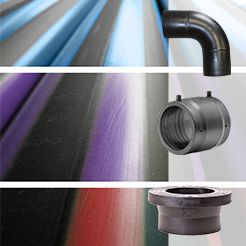
Pressure poly pipe is black, with coloured stripes or outer layers used to identify the service it carries. Correct identification helps prevent cross-connections and protects anyone excavating near an existing line in future.
| Colour | Service |
|---|---|
| Blue | Potable (drinking) water. See blue stripe poly pipe |
| Lilac | Recycled and non-potable water. See lilac stripe poly pipe |
| Red | Fire service mains. See red stripe poly pipe |
| Yellow | Gas reticulation. See gas poly pipe |
| Cream | Sewer |
| All black | General industrial, mining and irrigation applications where no service colour is required |
Common Poly Pipe Fittings Names and Their Uses
Fittings are identified by their joining method and function. The following are the types most frequently specified on poly pipe projects. Each fitting carries its own SDR and PN rating, which should equal or exceed that of the connected pipe.
| Fitting | Description |
|---|---|
| Buttweld fittings | Joined by heating the pipe and fitting ends against a heater plate and pressing them together. Includes bends, reducers, tees and end caps. See buttweld pipe fittings |
| Electrofusion fittings | Contain embedded heating coils, allowing a control unit to fuse the fitting to the pipe. Includes couplers, elbows, tees and saddles. See electrofusion fittings |
| Stub flange and backing ring | Used together to create a bolted connection between poly pipe and valves, pumps or metal pipework |
| Tapping saddle | Installed on a pressurised main to create a branch connection without cutting the pipe |
| Long spigot fittings | Feature extended ends so they can be electrofused or buttwelded directly into the pipeline |
Explore our complete range of poly pipe and HDPE pipe fittings.
Poly Pipe Supply Across Victoria, New South Wales and the ACT
Our Swan Hill head office coordinates supply operations and houses our poly pipe fabrication workshop, while orders are distributed from our Melbourne dispatch warehouse in Keilor Park.
Whether a project is in regional Victoria, metropolitan Melbourne, southern NSW or Canberra, our team can advise on suitable materials and coordinate delivery. View our full poly pipe range or learn more about Matrix Piping Systems.
Expert Advice on Selecting the Right Pipe Rating for Your Project
If you are unsure which PE grade, PN rating or SDR is appropriate for your application, our team can help. Provide details of the service, operating pressure, temperature and pipe diameter, and we will recommend suitable pipe and fittings and confirm availability. Answers to common ordering and installation questions are also available in our poly pipe FAQs.
Request technical advice from our team.
Frequently Asked Questions About Poly Pipe Terminology
What does PE mean on a pipe?
PE stands for polyethylene, the thermoplastic material used to manufacture poly pipe. The number that follows, such as PE100 or PE80, indicates the material's strength grade.
What is PN16 pipe?
PN16 pipe is rated for a continuous working pressure of 16 bar (1,600 kPa) at 20°C. In PE100 material, PN16 pipe is manufactured to SDR11.
What does PN stand for in pipes?
PN stands for nominal pressure. It is the maximum continuous working pressure, measured in bar, that a pipe is designed to carry at 20°C.
What does PE100 mean?
PE100 is a high density polyethylene grade with a Minimum Required Strength of 10 MPa over a 50-year design life at 20°C. It allows a thinner wall than PE80 for the same pressure rating.
Is PE100 the same as HDPE?
PE100 is a grade of HDPE. HDPE describes the material type, while PE100 identifies its specific strength classification.
What is the difference between SDR and PN?
SDR describes the ratio of a pipe's outside diameter to its wall thickness, while PN describes its pressure rating. For a given PE grade, each SDR corresponds to a fixed PN rating, so PE100 SDR11 pipe is always PN16.
Sales + Customer Service:
Head Office:
5 Richards Rd Swan Hill Victoria 3585
Melbourne Despatch:
2 Richards Circuit, Keilor Park Victoria 3042
(by appointment only)